
Big ideas from around the world, circular fitouts, AI and electrification were all up for discussion at the popular Green Property Summit 2026.

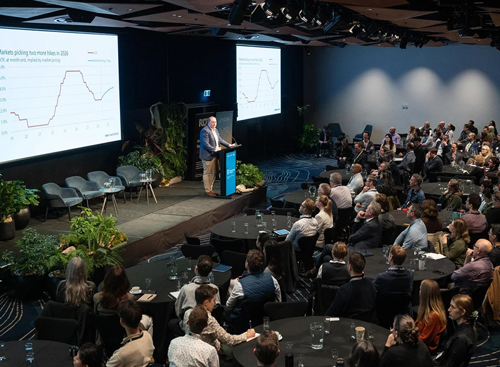
More than 350 property, construction, sustainability and government leaders gathered at the sell-out Green Property Summit 2026 in Auckland on 11 August to explore the economic, environmental and political forces shaping New Zealand's built environment.
From global architecture and electrification to AI, circular fitouts and election-year policy debates, the day highlighted a common theme: future-proofing buildings and communities requires long-term thinking, collaboration and practical action.
Economic outlook: navigating uncertainty
Infometrics Principal Economist Brad Olsen opened the summit with an overview of the economic forces influencing commercial property investment and development decisions.
Key takeaways:
Inflation remains a significant concern for businesses and investors
Energy costs continue to rise, placing pressure on households and organisations
Commercial rents are increasing despite a softer market in some centres
Businesses are becoming more selective about investment decisions and seeking stronger value from assets
Sustainable, efficient buildings can help reduce operating costs while supporting workforce wellbeing
Work-from-home trends appear to have stabilised, with hybrid working now firmly embedded
International keynote: big ideas from around the world
Kai-Uwe Bergmann from BIG (Bjarke Ingels Group) shared examples of global architecture projects that combine innovation, sustainability and human experience.
Key takeaways:
Small, thoughtful projects can have an outsized impact on communities
Mass timber and prefabrication are enabling new approaches to affordable, low-carbon construction
Buildings should work with natural landscapes rather than against them
Rainwater management can create environmental and social value
Emerging technologies such as photovoltaic building materials are opening new opportunities for energy generation
Investing more time in design and planning often delivers significant benefits during construction and operation, time at the design stage is crucial
Green Star in action: from theory to delivery
Representatives from 42 Ponsonby and Kärcher Auckland shared lessons from pursuing Green Star certification through very different project types. The panel featured Simon Wilson, Director RDT Pacific, Manoj Kumar, Senior Project Manager RDT Pacific, Bridget Pyć , Property Sustainability Manager, Samson Corporation (42 Ponsonby) and Marcus Bunn, Senior Project Manager, Savory (Kärcher). 42 Ponsonby was officially recognised with New Zealand's first Green Star Buildings certification.
Key takeaways:
Early commitment to sustainability simplifies project delivery
Collaboration between developers, consultants and contractors is critical
Green Star Buildings provides a practical and accessible framework
Sustainability outcomes can still be achieved even when projects don't start with certification in mind
Cultural and site history considerations helped shape the vision for 42 Ponsonby
Focusing on long-term occupant experience creates better outcomes than simply chasing credits
Smarter electrification: reducing costs and risk
A panel discussed practical pathways for buildings to transition away from using fossil gas. The panel featured Sam Archer, Director of Transformation, New Zealand Green Building Council (Moderator), Ellie Callard, Sustainability Manager, Auckland Airport, Chris Whiteley, Director of Facilities Management, Colliers Real Estate, Scott Smith, Technical Director of Sustainable Buildings, Beca.
EECA's Kate Gunthorp, Director, Commercial & Investment, provided an overview of expert advice and support options to help with getting investment ready. She also covered business access to lower cost bank finance under the new Gas Transition Loan Guarantee Scheme to improve energy resilience and prepare for the future.
Key takeaways:
Gas supply constraints are expected to increase in coming years
Gas prices have risen substantially and are likely to continue increasing
Electrification is becoming a key climate and resilience strategy
Energy efficiency should be the first step before larger retrofit projects
Heat pumps are providing significant operational and financial benefits
Businesses should view gas dependence as a strategic risk requiring active planning
Doing nothing is no longer the low-risk option
AI and sustainable buildings
AI leaders from Mott MacDonald, WT Partnership, Performance Building Technologies and Innovation Activator explored the opportunities and challenges of artificial intelligence.
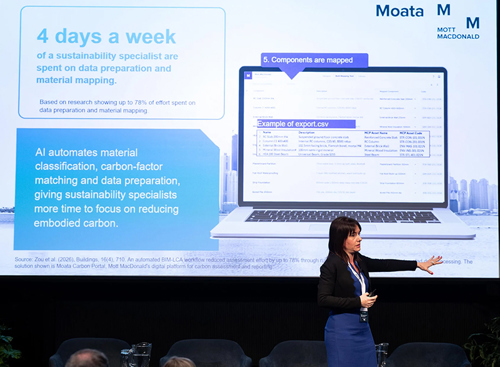
Maria Mingallon, AI Leader APNA, Mott MacDonald, Deputy Chair, AI Forum NZ gave a thought-provoking keynote on the forces shaping AI use in property and construction. She was later joined in a panel by Nick Sterling, Founder & Chief Executive, Innovation Activator, Jon Sinclair, Digital Services Director, Performance Building Technologies and Alex Hampshire, Director, Advisory, WT Partnership.
Key takeaways:
AI should be viewed as a tool that augments human judgement rather than replaces it
Strong governance and data management remain essential
AI can improve carbon assessments, compliance processes and project delivery
Building operations and performance optimisation are emerging use cases
Organisations need clear objectives before implementing AI solutions
Good-quality, trusted data remains the foundation for successful AI adoption
The focus should be on ‘better AI’, not simply more AI
NABERSNZ: energy performance driving business value
Bobby Shen, Impact Manager - Buildings, New Zealand Green Building Council and Frankie L'Estrange, Head of Sustainable Finance, ASB Bank examined how NABERSNZ is evolving and why energy performance is becoming more important for building owners and investors.
Key takeaways:
NABERSNZ continues to expand into additional building sectors
Energy performance is becoming increasingly important for tenants
Performance ratings provide trusted verification and benchmarking
Sustainable finance opportunities are growing for highly performing assets
Better-performing buildings face lower stranded-asset risk
Significant gains can often be achieved by improving lower-performing buildings
Building owners should engage tenants, understand their current performance and talk to their bank about finance options
Circular fitouts: moving into the mainstream
Davina Rooney from the Green Building Council of Australia explored why circularity is becoming a global priority and how the new Green Star Fitouts is performing across the Tasman.
Key takeaways:
Nature loss and resource use are becoming major business risks
Fitouts generate substantial waste and embodied carbon
Occupiers increasingly expect workplaces that justify the commute
Circular fitout approaches can reduce waste while improving flexibility
Modular systems allow spaces to be more easily adapted and reused
Circularity is rapidly moving from a niche concept to a mainstream expectation
Reimagining fitouts for the future
Industry leaders discussed practical opportunities to reduce waste and carbon through better fit-out practices.
Joe Quad, Technical Development Lead, New Zealand Green Building Council (Moderator) was joined by Lizzie Whaley , Chief Executive, Spaceworks, Dave Moolman, Vice President of Strategic Accounts & Sustainability, Shaw Contract and Martin Skinner , President, NZ Retail Interiors Association. Spaceworks has registered New Zealand's first Green Star Fitouts project undertaking a fitout at 2 Degrees Riccarton store in Christchurch.
Key takeaways:
Fitouts represent a significant source of embodied carbon
Flooring replacement is one of the biggest contributors to waste
Reuse and recovery rates remain relatively low across the sector
Small projects can still achieve significant waste reduction outcomes
Circular approaches can deliver strong results without significant cost increases
Repeatable, easy-to-use tools are critical for widespread adoption.
Making Green Star more accessible
NZGBC introduced its new guide designed to support more 4 Star Green Star projects.
Key takeaways:
Green Star is not only for premium developments
The new guide aims to simplify the certification process
Smaller projects can achieve credible sustainability outcomes
Sustainable finance opportunities are increasingly linked to recognised ratings and certifications
Election-year political panel: priorities for the built environment
Representatives from National, Labour, ACT, New Zealand First, the Green Party and Opportunity discussed infrastructure, housing, energy and resilience.
Key takeaways:
There was broad support for improving infrastructure planning and delivery
Energy security emerged as a major issue across the political spectrum
Several panellists highlighted the need for long-term infrastructure and energy strategies
Building resilience to climate impacts remains a growing challenge
Planning, consenting and regulatory reform featured prominently
Workforce capability and apprenticeships were identified as critical priorities
There was support from multiple parties for greater transparency around building energy performance
In summary
In his summit closing, NZGBC Chief Executive Andrew Eagles summarised:
Strong sector engagement, including 600+ members, 450+ people trained annually across 27 courses, and 35+ webinars and industry events each year
Certification momentum is a central theme, with Green Star, NABERSNZ, Homestar, HomeFit and Carbonzero presented as independent tools that create measurement, reporting, disclosure and transparency
There have been many new Green Star certifications and growing interest in Green Star Communities, particularly in multi-purpose developments in Auckland and Waikato
Advocacy wins include retaining stronger insulation requirements, changes to H1, support for lower-interest funding to shift buildings off gas, and development of whole-of-life carbon methodology
Following the event, Eagles commented, “What an incredible day. With a packed programme, insightful discussions, and plenty of opportunities to connect, I would like to extend a huge thank you to everyone who helped make the Summit such a success, including our speakers, panellists, sponsors, exhibitors and attendees.
“We've received some fantastic feedback from those who joined us, and we're delighted to hear how people valued the mix of practical insights, industry expertise and inspiring conversations. Ticket sales were up 40% on last year. For this to happen at a time of uncertainty for the construction and property sector is a real sign that there is strong interest in healthy, efficient buildings and communities.
“We hope attendees left feeling energised, equipped with new ideas, and better connected with others who share a passion for creating a better built environment.”

To learn more about sustainable green homes see:


 Copy link
